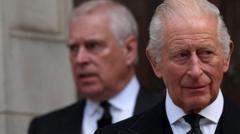
King's funding for Andrew not to be used for legal action against police
King Charles provides a private allowance for Andrew Mountbatten-Windsor
Andrew Mountbatten-Windsor has been told that the allowance given to him by King Charles should not be used to fund his legal action against Thames Valley Police and the Central Criminal Court.
The King uses his own private money to support his brother and to accommodate him on his estate in Sandringham.
But a royal source said that this funding should not be used for a legal challenge being launched by Mountbatten-Windsor against the search warrants issued ahead of his arrest in February.
The former Prince Andrew was arrested on suspicion of misconduct in public office in the wake of information that emerged from the Epstein files in the United States.
Andrew Mountbatten-Windsor photographed leaving a police station in February
Mountbatten-Windsor has consistently denied any wrongdoing linked to his association with Epstein.
The former Prince Andrew is not a working royal - so Buckingham Palace no longer speaks on his behalf and is not involved in his legal battle.
But a royal source said the King's financial support for his brother should not be directed towards paying for the judicial review that Mountbatten-Windsor is seeking.
It's not been disclosed how much the King gives to Mountbatten-Windsor, but the funding for his brother was part of the arrangement when the former Prince Andrew was moved from his previous home at Royal Lodge in Windsor.
This allowance for Mountbatten-Windsor is not from the Sovereign Grant, which is the £138m in public funding for the monarchy.
It is drawn from the King's private money, which includes his income from the Duchy of Lancaster, private estates and his own investments and inheritances.
At the time of Mountbatten-Windsor's arrest, the King said the "law must take its course", and the Palace is now distancing itself from the former Duke of York's legal pushback.
Mountbatten-Windsor's lawyers are understood to be challenging Thames Valley Police and the Central Criminal Court over the lawfulness of warrants used for searches of Sandringham and Royal Lodge - in what has been Andrew's first public response since his arrest earlier this year.
Thames Valley Police has confirmed it is "engaged in legal proceedings in relation to warrants previously obtained from the Central Criminal Court".
It added: "As these legal proceedings are currently ongoing, it would be inappropriate for us to comment further."
Mountbatten-Windsor, who lost his titles as a prince and Duke of York over his connections to the sex offender Jeffrey Epstein, wants a judicial review to consider the legality of the search warrants.
A court hearing on Thursday afternoon will be part of Mountbatten-Windsor's bid to quash the warrants.
Why was Andrew Mountbatten-Windsor arrested and what happens next?
How Andrew's 11-hour detention on his birthday played out
Shell-shocked, haunted photo of Andrew will be part of how arrest is remembered
The warrants had been issued by a judge at the Central Criminal Court on 18 February - the day before Mountbatten-Windsor was arrested in Sandringham.
"Even if Andrew succeeds in having the search warrants quashed, that would not necessarily be the victory it might first appear," said Nick Vamos, a criminal lawyer at Peters & Peters and former head of special crime at the Crown Prosecution Service.
Vamos said disputes over warrants were not uncommon - but if the police lost on a technical error, they could still sometimes keep what they had obtained in a search.
"The police can apply back to the Crown Court to retain the material if they have grounds to immediately seize it again," said Vamos.
It would need to be a more fundamental issue with the granting of the warrants for the police to be required to return the material from a search, he said.
Mountbatten-Windsor's arrest, carried out on his 66th birthday, followed a series of revelations from the Epstein files, published by the US Department of Justice.
They included emails appearing to show official documents being shared by Mountbatten-Windsor with Epstein and others, at a time when he was the UK's trade envoy.
Mountbatten-Windsor had already been stripped of his titles by King Charles, after emails had shown Mountbatten-Windsor had continued his links with Epstein, beyond when he had publicly said connections had been severed.
After Mountbatten-Windsor's arrest he was taken to Aylsham police station. A photograph captured his departure later that day, looking exhausted, after he was released under investigation.
Sign up here to get the latest royal stories and analysis every week with our Royal Watch newsletter. Those outside the UK can sign up here.